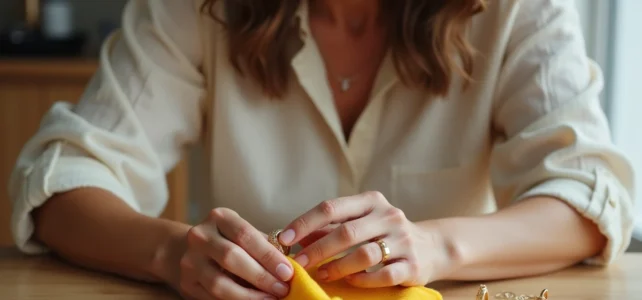
The chamoisine is a very fine cotton fabric, often treated with micro-polishing agents, designed to polish metal surfaces without scratching them. In the field of jewelry, it is used to remove superficial oxidation marks on silver, gold, or vermeil by simple dry rubbing, without the need for a liquid product.
Impregnated chamoisine or simple microfiber: two fabrics, two distinct uses
The confusion between chamoisine and microfiber cloth often arises. Both are soft to the touch, but their action on a piece of jewelry differs radically.
An impregnated chamoisine contains slightly abrasive or anti-oxidant agents integrated into the fibers. It removes visible tarnish in just a few passes, making it effective for spot polishing. On a tarnished 925 silver bracelet that has not been maintained for several weeks, the result is immediate.
A classic microfiber, on the other hand, only moves surface residues (sebum, dust) without any chemical or abrasive action. It is suitable for daily wiping after wearing, but does not restore the shine of oxidized metal.
The trap lies in the repeated use of the impregnated chamoisine on delicate jewelry. On a fine gold-plated piece, the micro-abrasives can accelerate the wear of the plating layer if the cloth is used every day. The operational rule: microfiber for daily use, impregnated chamoisine for spaced polishing, once or twice a month at most. Knowing how to use a chamoisine for jewelry correctly prevents premature wear of fragile pieces.
Dry maintenance before any product: the chamoisine as the first step
Most maintenance guides directly suggest recipes using baking soda, white vinegar, or warm baths. This approach skips a step that can change the final result.
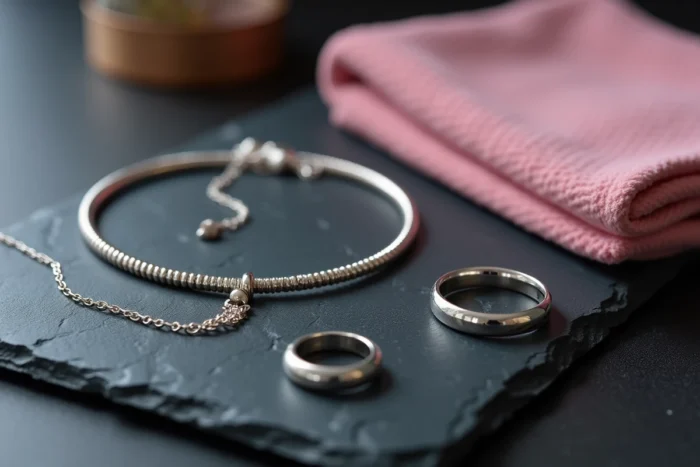
Rubbing the jewelry dry with a chamoisine before any liquid contact helps remove the layer of grease and dust that acts as a barrier. A cleaning bath works better on metal that is already free of superficial residues. On a set ring, this step also prevents trapping particles between the stone and the setting during soaking.
The action is simple: wrap the jewelry in the chamoisine, then rub with straight movements (not circular) applying light pressure. Circular movements create fine concentric micro-scratches that are visible under low-angle light, especially on polished silver.
Case of openwork jewelry and glued stones
On a necklace with openwork patterns or a pendant where the stone is held by a drop of glue (common in handcrafted jewelry), the chamoisine does not serve as the main cleaner. It is used as a finishing touch after gentle brushing with a soft-bristled brush.
The fabric can get caught in the crevices of openwork jewelry. It is better to fold the chamoisine into a narrow strip and work section by section, rather than wrapping the entire piece. For glued stones, avoid any firm rubbing on the setting area: the glue does not withstand repeated mechanical stress well.
Chamoisine and intentional patina: a conflict to anticipate
Some silver jewelry is sold with an intentional patina, a darkening applied in the recesses to enhance the relief of the pattern. This is the case for many sculpted rings or pendants with recessed decorations.
The impregnated chamoisine does not distinguish between accidental oxidation and the desired patina. Rubbing a patinated piece risks removing the decorative contrast that the jeweler has established. The metal becomes uniformly light again, and the readability of the pattern decreases.
For these pieces, two precautions:
- Use only a non-impregnated cloth (microfiber or untreated natural chamoisine) to dust the raised surfaces.
- Limit rubbing to the raised and smooth areas, avoiding the recesses where the patina is concentrated.
- If the patina has faded over time, a jeweler can reapply it with a liver of sulfur solution, but this operation should not be done at home without experience.

When to replace a chamoisine for jewelry
An impregnated chamoisine does not last indefinitely. The polishing agents wear out over time, and the fabric accumulates microscopic metallic residues that eventually scratch instead of polish.
Two signals indicate that it is time to change:
- The fabric shows persistent dark areas that do not wash out. These deposits are embedded metallic particles.
- The rubbing no longer produces visible improvement on a slightly tarnished piece: the cleaning agents are exhausted.
- The fabric has been machine washed with a fabric softener, which clogs the fibers and cancels the polishing effect.
Washing and storage
An unimpregnated chamoisine can be hand washed in warm water with neutral soap and then air dried. An impregnated chamoisine, however, is generally not washable: washing removes the active agents. The manufacturer often specifies on the packaging whether the fabric is washable or not.
For storage, a sealed bag or a clean fabric pouch is sufficient. Leaving a chamoisine exposed in a bathroom drawer exposes it to moisture and perfume splashes, two factors that degrade its properties.
The choice between impregnated chamoisine and neutral fabric depends on the metal, the frequency of wear, and the type of finish of the jewelry. Proper maintenance preserves the shine of a ring or bracelet over the long term, without systematically resorting to chemical solutions.