
You’re changing cities for a few months, living in a van, or you’re an expatriate without a fixed home in France. However, bills, administrative mail, and registered letters continue to arrive. The question quickly arises: where to collect all this without a mailbox in your name? Several options exist, from the most institutional to the most flexible, each catering to a specific profile.
Mail digitization and virtual mailbox: the digital pivot
Online competitors often focus on the classic mailbox or Poste restante. They overlook a fundamental trend: the systematic digitization of mail on demand. In practical terms, a provider assigns you a real street address. Each envelope received is scanned, and you can view its contents from an app or an online space.
This type of service, sometimes called a “virtual mailbox,” goes beyond simple storage. You can request the opening of a specific piece of mail, archive important documents in a digital safe, or initiate a physical forwarding to a pickup point or a temporary address.
Why is this model so appealing? Because it removes geographical constraints. A vanlifer working in Portugal, an expatriate in Canada, or a freelancer constantly on the move can access their French mail without delay. You can also receive your mail elsewhere with Brico Déco Home to discover other practical options suited for nomads.
Before subscribing, check three points:
- Is the provided address a street address (not just a PO box), accepted by tax authorities and banks?
- Does the provider offer parcel forwarding in addition to letters, and to which countries?
- What is the average time between the physical receipt of mail and its online digitization?
A digital pivot address replaces the physical mailbox for those without a stable residence. It is the technical foundation on which most modern solutions are based.

Mailing address via a CCAS: the right to mail for homeless individuals
Receiving mail is not a luxury; it is a right. In France, anyone without a stable home can request a postal address from a CCAS (Centre Communal d’Action Sociale) or an approved organization. This procedure, governed by the social action code, allows you to obtain a valid administrative address for everyday tasks: identity card, social benefits, registration on electoral rolls.
The process is simple. You go to the CCAS of the municipality where you have a connection (place of stay, last known residence). After an interview, the organization assigns you its address. Your mail is received there, and you can collect it on-site during opening hours.
Concrete limitations of the CCAS system
CCAS domiciliation is reserved for individuals without a stable home. It does not cover expatriates or nomadic workers by choice. The duration is limited, usually one year renewable, and the organization can terminate it if you do not check in regularly.
Another constraint: mail retrieval depends on the center’s hours. There is no digitization, no email notification. For someone in great precariousness, it is an administrative safety net, not a daily mail management tool.
Receiving mail at a third party’s address or Poste restante: two options to distinguish
You may have a friend, relative, or former roommate willing to receive your letters. This is legal, provided you follow a few rules. The third party must give their written consent, stating the exact address, start date, and the identities of both parties. If the residence is in a co-ownership or rental, check that neither the co-ownership rules nor the lease prohibits this practice.
Domiciliation at a third party works well for a defined period: an ongoing move, a stay abroad for a few months. Beyond that, it becomes burdensome for the host and legally fragile if the administration requests proof of residence.
Poste restante: the occasional solution
Poste restante allows you to have letters and parcels sent to the post office of your choice. You collect them by presenting an ID. The service is paid, charged per item or as a subscription depending on the chosen plan.
This is a transit solution, not a sustainable management option. Mail is kept for a limited time, after which it is returned to the sender. You must also inform each correspondent of the exact address of the post office, with the mention “Poste restante.”
- At a third party’s address: free, flexible, but requires formal agreement and a relationship of trust
- Poste restante: accessible everywhere in France, but paid and time-limited
- Virtual mailbox: also paid, but with digitization, forwarding, and remote management
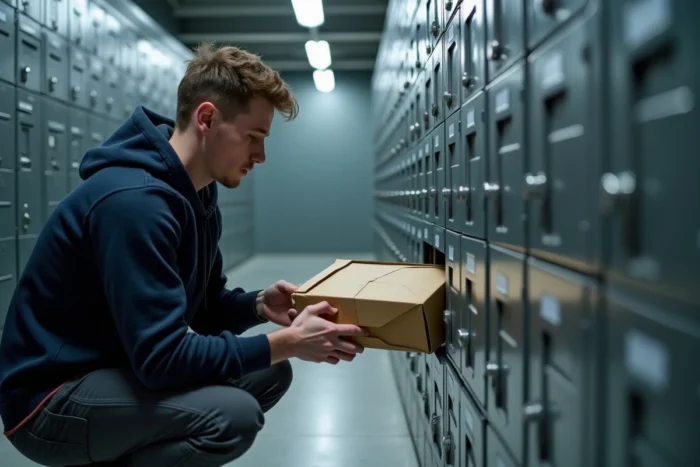
Mail forwarding and redirection: anticipate rather than endure
Even before you find yourself without an address, you can organize the transition. The La Poste forwarding service automatically redirects your mail to a new address for a chosen duration. It is the classic solution when moving, but it also works for a mailbox or a third party’s address.
Forwarding does not cover all mail. Non-forwardable mail (some registered letters, institutional mail coded NPAI) remains pending or is returned to the sender. Be sure to update your address directly with priority organizations: bank, insurance, taxes, social security.
Combining multiple solutions
The most reliable strategy is to combine two solutions. For example: a temporary forwarding to a virtual mailbox while establishing a new anchor point. Or a domiciliation with a relative coupled with occasional scanning of urgent mail via a digitization service.
No single solution covers all scenarios. The choice depends on your situation: expected duration without a fixed address, volume of mail received, need or not for recognized proof of residence by the administration. First, identify your administrative constraints, then choose the solution that meets them with the least friction possible.