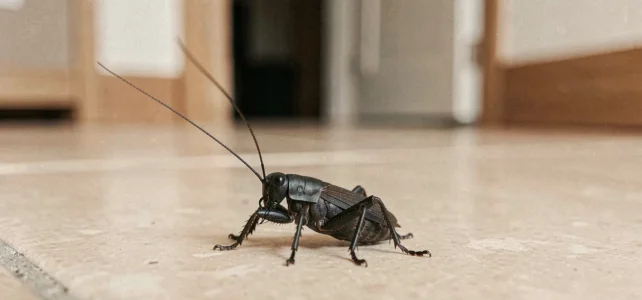
A black bug jumps onto the bathroom tiles, disappears between two joints, and reappears near the plant pot. Before pulling out an insecticide, it is wise to observe where, when, and on what surface this jumping black creature manifests. The room and the time of day guide the diagnosis much faster than the color or size of the animal.
Room, surface, and time: the three field clues that change everything
Most guides suggest comparing the critter to a list of species. In practice, it’s more efficient to first note the exact location of appearance. A small jumper spotted on a wet flower pot, another found on the dog’s quilt, and a third resting on a bag of flour do not require the same response.
A jumper near a source of moisture is almost never a flea. If the creature appears around houseplants, on a shower ledge, or at a damp baseboard, we lean towards a springtail. These organisms feed on microscopic mold and do not bite.
Conversely, when repeated jumps are observed on a carpet, a pet basket, or bedroom carpet, the flea becomes the priority suspect. Fleas bite, leave reddish marks clustered on the skin, and concentrate where a host (cat, dog, sometimes human) regularly sleeps or rests.
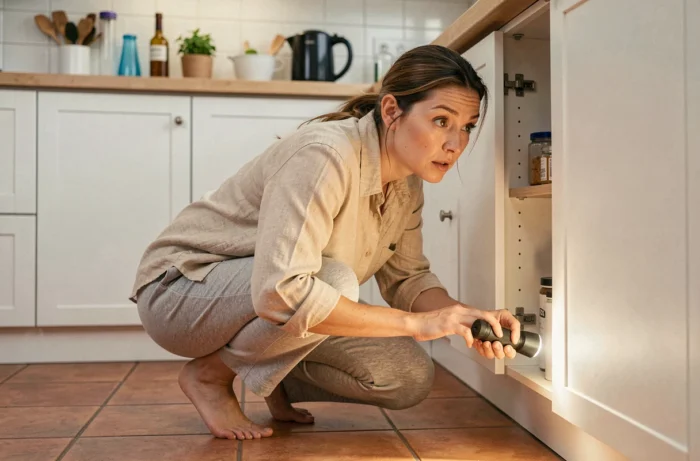
To reliably spot a jumping black bug in the house, we note three elements: the room, the surface (textile, plant, mineral, food), and the time slot. This simple method allows us to eliminate half of the hypotheses even before pulling out a magnifying glass.
Springtail or flea: the bite criterion settles the debate
These two critters make up the majority of cases of “small black insect that jumps in the house.” Their confusion is common because they have a comparable size (around a millimeter) and a lively jumping behavior. The fundamental difference lies in one point: the flea bites, the springtail never bites.
Recognizing a springtail without equipment
The springtail is not an insect in the strict sense. It belongs to non-insect hexapods, a nuance that has a direct practical consequence: classic insecticides often work poorly against it. It is recognized by its preference for humid areas, its complete lack of bite, and its tendency to form visible groups on a wet substrate.
If a springtail is crushed between the fingers, one feels almost nothing. It does not leave a trace of blood, unlike a engorged flea. Its body is soft, sometimes slightly elongated, and the color ranges from dark gray to black.
Confirming the presence of fleas
The adult flea has a laterally flattened body, hard to the touch. It jumps long distances relative to its size. Its presence is often detected by black comma-shaped droppings on sheets or the pet’s bedding. A simple test: place these small grains on a damp tissue. If they leave a reddish halo, they are flea droppings (digested blood).
Sticky trap: a monitoring tool, not a solution
The recommendation to set up sticky traps is frequently seen. In practice, these devices primarily serve to measure the extent of the problem and track its evolution, not to solve it. A sticky trap placed on the floor for two days, near a baseboard or at the foot of a flower pot, allows for counting captures and more easily identifying trapped species.
If the trap captures a handful of springtails in 48 hours, we know that the population remains moderate and that action on humidity will likely suffice. If several dozen fleas are found, the situation requires a more aggressive targeted treatment. The sticky trap is used to decide, not to eradicate.
Acting on indoor humidity before any chemical treatment
In the majority of cases involving springtails, the real lever lies in managing humidity. One can spray as much product as desired: as long as the humidity level remains high around baseboards, under the sink, or in a poorly ventilated bathroom, springtails will return.
Here are the concrete actions to prioritize:
- Check the ventilation of each humid room (functional VMC, unobstructed air vent) and correct air extraction defects
- Reduce watering of houseplants, systematically empty saucers, and allow the substrate to dry between waterings
- Seal degraded joints around the shower, bathtub, and under the sink, where micro-molds feed the colonies
- Move firewood stored indoors to a ventilated area: damp logs frequently host springtails
For fleas, the approach is different. We treat the animal simultaneously (appropriate antiparasitic prescribed by a veterinarian) and the environment (intensive vacuuming of textiles, washing bedding at high temperatures). Treating the animal without treating the house reignites the infestation within weeks.
When to call a pest control professional
Feedback varies on this point, but several situations clearly justify an external intervention:
- Bites persist despite antiparasitic treatment of the animal and thorough cleaning of the home for more than three weeks
- Springtails reappear after correcting humidity, which may signal a structural problem (infiltration in a wall, hidden leak)
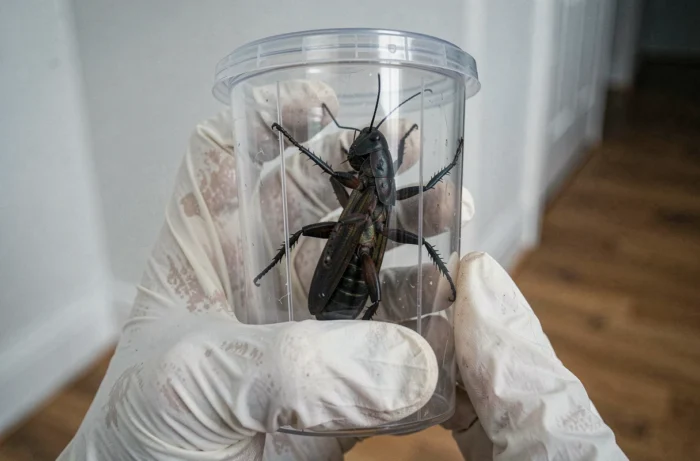
- An insect is identified that corresponds neither to a flea nor a springtail, notably a small beetle (attagen, weevil), indicating an infestation of food or textiles requiring a specific diagnosis
A professional will set up their own monitoring traps, identify the species with certainty, and adapt the protocol. Resorting to an exterminator remains the last resort, not the first reflex.
Before any chemical action, the sequence remains the same: observe the room and the surface, check for the presence or absence of bites, set a sticky trap to quantify, and then correct the cause (humidity or animal host). This step-by-step method avoids the majority of unnecessary treatments and addresses the problem at its source.