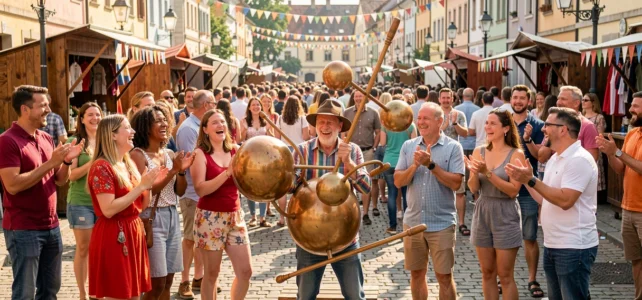
Organizing a memorable festive event requires selecting attractions that are suitable for the audience, the venue, and the format. The gap between classic inflatable attractions and recent immersive devices is widening. Understanding what truly works at a festive event helps avoid unnecessary expenses and focus the budget on what generates engagement.
Immersive and Interactive Experiences: What’s Changing in Festive Events
Have you ever seen a classic photo booth at a party? Now imagine a device that generates a personalized portrait based on the visitor’s reactions, or an augmented reality path that transforms a hall into a playground. This is the type of entertainment that is becoming essential in recent festive events.
The structuring trend identified by Public Anim for 2026 is based on three pillars: immersive events, interactive technologies, and eco-responsible approaches. Organizers who integrate these three dimensions observe stronger audience engagement, even in short formats.
In practical terms, this translates into experiences where the visitor no longer just watches but participates. A virtual reality workshop places each guest at the center of the experience. An interactive wall captures movements and adapts content in real-time.
These devices are no longer reserved for trade shows: they are deployed at municipal parties, weddings, or corporate anniversaries. Specialized providers like those listed on joker-amusement.com offer a catalog of attractions suitable for different formats of festive events.
Eco-Responsible Attractions for Events: A Technical Criterion
Eco-responsibility in event entertainment is no longer limited to eliminating plastic cups. It now extends to the very choice of attractions.
Wooden games and human-powered activities are gaining ground. A smoothie bike, where the participant’s pedaling powers a blender, combines playful entertainment with an ecological message without moralizing discourse. Inflatable structures made from recycled materials are starting to appear among some rental companies.
The Yeahpa site lists sustainable activities designed to reduce the carbon footprint of an event. The idea is not to forgo the spectacular but to rethink logistics. An attraction that can be transported in a single utility vehicle instead of three has a direct impact on the carbon balance, in addition to simplifying setup.
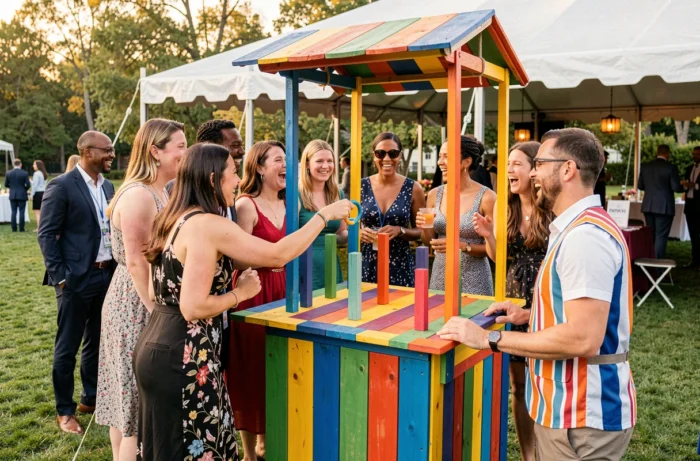
- Oversized wooden games (pucks, skittles, mazes): low energy consumption, quick setup, suitable for all ages
- Creative workshops using recovered materials: customization possible according to the event theme
- Eco-designed inflatable structures: some manufacturers use fabrics sourced from textile recycling
- Human-powered activities (generator bikes, mechanical courses): zero electricity, high participatory potential
This eco-responsible shift also responds to a growing regulatory expectation. Local authorities are increasingly incorporating environmental criteria into their calls for tenders for public festivities.
Personalization of Festive Activities Through Data
Why offer the same activity to a group of executives at a seminar and to families at a neighborhood party? The personalization of guest experiences through data is described by Publithings as a major trend in corporate events in 2026.
Custom guest experiences replace the one-size-fits-all program. In practice, a pre-event questionnaire or a dedicated app allows for the segmentation of participants. Each group accesses targeted activities based on their interests. A booth can offer a sports challenge to some and a culinary workshop to others, in the same space.
This approach also works for public events. At festivals, some organizers use connected wristbands that guide visitors to the least crowded attractions, reducing wait times and enhancing the overall experience.
What This Changes for Choosing a Provider
A provider that only offers a fixed catalog of attractions no longer meets current expectations. The ability to adapt the entertainment to the audience profile is becoming a selection criterion on par with price or logistics.
Before signing, ask the provider three questions:
- Can they adjust the content of the entertainment based on the age or profile of the participants?
- Do they have quantified feedback on similar events to yours?
- Do they handle setup, safety, and teardown, or are these responsibilities yours?
Safety and Regulation of Event Attractions
Festive attractions, particularly inflatable structures and temporary rides, are subject to strict safety obligations. Checking the provider’s insurance and certifications is not a formality: it is legal protection for the organizer.
An inflatable installed without proper anchoring or supervision can lead to the organizer’s civil liability, even if they hired a professional. Always request the professional liability insurance certificate and the technical inspection report of the structures.
For outdoor events, weather remains the main risk factor. A backup plan (indoor fallback, protective tarp, rescheduling) must be included in the contract. Experienced providers include this clause; those who do not warrant scrutiny.
The choice of a festive attraction is not limited to its price or visual effect. The regulatory framework, the ability to adapt to the audience, and the environmental impact now weigh equally in the decision. A successful event relies on a few well-chosen activities, not on an accumulation of generic booths.