
Two sturdy trees, a piece of rope, a seat: the project seems clear. The technical reality is a bit less so. Fixing a swing between two trunks requires solving a problem that classic frames avoid, that of the variable distance between anchor points and the living reaction of the wood. Here’s how to approach this project without damaging your trees or compromising safety.
Why the ground under the swing matters as much as the attachment
Most tutorials focus on the straps and the seat. The ground below, however, receives less attention even though it absorbs every fall.
The DIN EN 71-8 standard, applicable to domestic play equipment, requires a free space of at least two meters all around the swing. It also demands a shock-absorbing surface: sand, wood chips, or rubber mats. A closely mown lawn does not fulfill this function. Summer compaction hardens the soil and reduces its absorption capacity.
Local wood chips are the most accessible solution. Spread out to a generous thickness, they absorb impacts well and blend into a garden. Remember to define the landing zone before fixing anything at height: it determines the final positioning of the seat, not the other way around.
For those who wish to build a swing between two trees properly, this ground constraint guides the entire project from the start.
Choosing the trees and checking their strength
You’ve spotted two well-spaced trunks at the back of the garden. Before taking out the drill, ask yourself a simple question: are these trees healthy?
A sick or hollow tree can give way under a dynamic load, even a modest one. Visually inspect the bark at the attachment height. Fungi, cavities, longitudinal cracks, or dead branches above the swinging area are warning signs. If in doubt, a professional tree surgeon can assess the wood’s strength in a few minutes.
Which species support a load well
Hardwood trees (oak, beech, hornbeam) tolerate lateral tension better than softwoods. A poplar or willow, even large, has soft wood that deforms under repeated stress. Opt for a trunk with a comfortable diameter at the attachment height, straight, without a marked inclination towards the play area.
Distance between the two trunks
If too close, the trees do not allow enough swing amplitude. If too far apart, the horizontal beam bends under the weight. A gap of three to four meters between the trunks offers a good compromise for a simple seat. Beyond that, a thicker beam or a central reinforcement is needed, complicating the assembly.
Straps, carabiners, and beam: the right equipment
The choice of fastening equipment determines the longevity of the installation and the health of the trees. Two approaches coexist, and they are not equal.
- Flat ratchet straps, wide and doubled, distribute pressure on the bark and limit strangulation of the trunk. They adjust each season as the tree grows.
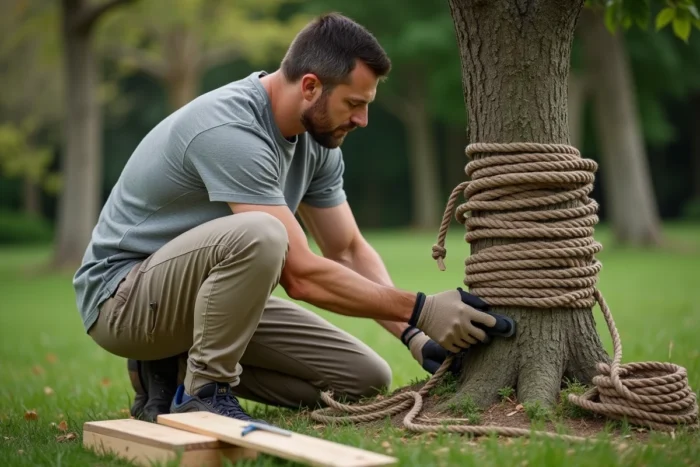
- Ropes wrapped directly around the trunk create a friction point that can cut into the bark in a few months. To be avoided on a living tree.
- Steel screw carabiners ensure the connection between the strap and the beam. Check that the breaking load far exceeds the maximum expected weight, including children and adults.
For the beam, a treated wooden post withstands the weather. Drill it at the locations of the seat’s suspension hooks, then connect it to the straps via the carabiners. Each junction point should be visually inspected before each season.

Attaching the seat and adjusting the suspension ropes
The seat is suspended from the beam by two ropes or two chains. Braided polypropylene ropes resist UV and moisture well, but they stretch slightly over time. Galvanized chains do not move, but they can pinch children’s fingers. A soft plastic cover on the links solves this problem.
Height and tilt of the seat
Adjust the height of the seat according to the age of the users. For young children, the seat should be low enough for them to get on and off by themselves, with their feet flat on the ground while sitting. A stop knot under each attachment point prevents the rope from slipping through the seat’s eyelet.
Check the horizontal alignment of the wooden seat. A slight tilt backward causes imbalance with each push. Two symmetrical adjustments of the ropes are enough to correct the issue.
Seasonal maintenance and limits of mounting between trees
A swing between two trees lives in sync with the vegetation. The trunks grow, the straps tighten, the beam can twist if the wood shifts after a wet spell.
- In spring, loosen and reposition the straps to avoid strangling the bark. Add a thick felt spacer if marks appear.
- In summer, check the wear of the ropes and the integrity of the carabiners. The sun weakens synthetic fibers exposed continuously.
- Before winter, disassemble the seat and the beam to relieve the trees. Store the equipment in a sheltered place.
This type of installation requires more maintenance than a ground-anchored frame. The trade-off is a natural look, minimal clutter, and the possibility of transforming the same structure into a hammock or climbing net depending on the season, in line with the modular play areas that families increasingly seek.
The last point to keep in mind: a tree is not an industrial pole. It moves, it grows, it reacts to the wind. Monitor it as closely as you monitor the attachments, and your swing will last as long as it does.