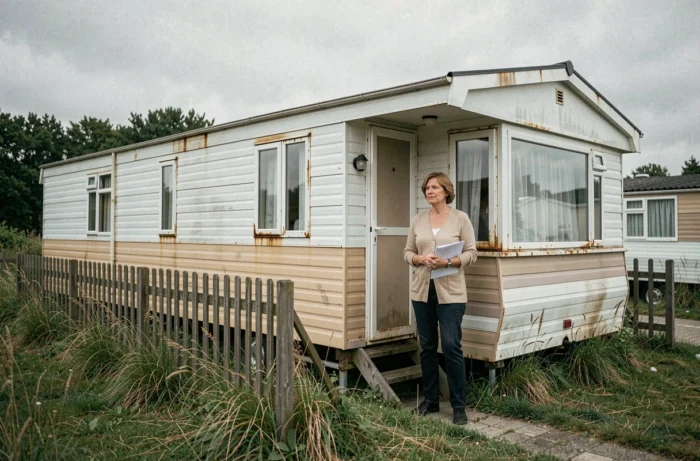
In Belgium, the issue of the future of old mobile homes regularly comes up in discussions between plot owners in campsites and managers of residential leisure parks. The Belgian legal framework does not operate like that of France, and the confusion between the two systems fuels many misconceptions. Understanding the current legislation on mobile homes over 20 years old first requires distinguishing between what falls under regional law, private contracts, and urban planning standards.
Mobile homes over 20 years old in Belgium: an age threshold without federal legal basis
The starting point for any analysis is simple: no Belgian federal law sets the age of 20 years as a limit for the use or maintenance of a mobile home on a site. This threshold, often mentioned by owners, actually comes from contractual practices imposed by certain campsites or from French regulations, where managers of residential leisure parks can require the replacement of a unit beyond a certain age.
Under Belgian law, the determining criteria do not focus on the age of the mobile home but on its placement, its actual mobility, the use made of it (residential or recreational), and the compliance of the land. A 25-year-old mobile home installed on authorized land, in good condition and meeting the lease conditions, therefore has no legal reason to be removed solely based on its age.
On the other hand, a recent model placed without authorization or on land not intended for leisure may be in violation, regardless of its condition. It is the use and the location that take precedence, not the manufacturing date.
To better understand the concrete implications, consult this analysis of the current legislation on mobile homes over 20 years old.
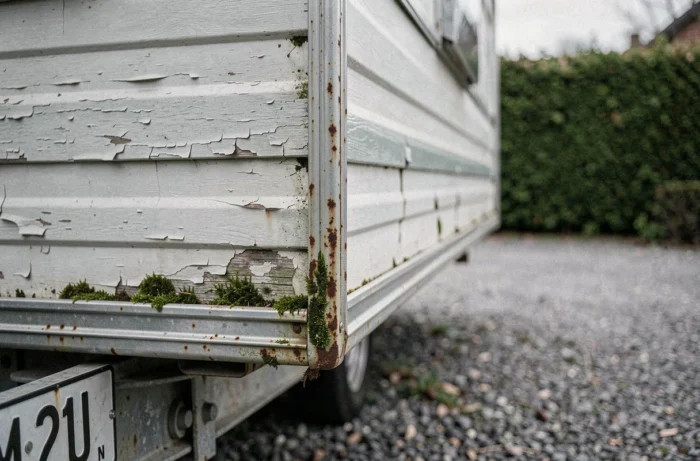
Regional regulations in Belgium: Flanders, Wallonia, and Brussels
Belgium operates with three regions that have their own competencies in urban planning and land use. This distribution creates notable differences in the treatment of mobile installations, including old mobile homes.
Flanders: environmental permits and mobile constructions
In Flanders, even a construction without traditional foundations may fall under environmental authorization rules. The criterion used is not the nature of the building but its permanent or semi-permanent character on the ground. A mobile home placed on blocks for several years, connected to utilities, can be considered a fixed construction requiring a permit.
Mobile home owners in Flanders must check whether their site has the required authorizations, regardless of the age of the unit.
Wallonia: the CoDT and camping grounds
The Code of Territorial Development (CoDT) regulates land occupation in Wallonia. Installing a mobile home on an authorized camping site generally does not pose a problem, provided that the site manager holds the necessary permits. However, installing a mobile home on private land outside leisure zones may require an urban planning permit, even if the unit retains its wheels and chassis.
The CoDT does not mention an age limit for mobile units. The question concerns the destination of the land and the nature of the occupation.
Brussels: a marginal case
The Brussels-Capital Region is not affected in the same way, as camping grounds are virtually non-existent there. The few situations involving a mobile home fall under the common law of Brussels urban planning.
Camping contract and internal regulations: the real source of obligations
If Belgian law does not set an age threshold, where does the pressure felt by owners of old mobile homes come from? In the vast majority of cases, it is the contract with the campsite manager that imposes the replacement.
The internal regulations of many residential leisure parks include clauses related to the condition, aesthetics, or age of the installations. A manager may require that a mobile home be replaced after a certain number of years, not by virtue of a law, but based on the contract signed between the parties.
- Some campsites impose a replacement every 15 to 20 years to maintain the visual homogeneity of the park and its commercial value.
- Others limit themselves to maintenance criteria: as long as the mobile home is clean, waterproof, and in good condition, it can remain.
- Failure to comply with the internal regulations may lead to the termination of the site contract, with a notice period varying according to the terms of the lease.
Before contesting a replacement request, the first step is to thoroughly reread the rental contract for the site and the internal regulations of the campsite. Possible recourse depends on what is stated therein.
Permanent residence in a mobile home: a special status in Belgium
The permanent residential use of a mobile home raises distinct questions from recreational use. Establishing residence in a mobile home on a camping site is technically possible in Belgium, but the conditions vary by region and municipality.
In the Brussels-Capital Region, if a campsite owner agrees that the tenant establishes their primary residence there, the lease can be reclassified as a primary residence lease, with the protections that come with it. This situation remains governed by two cumulative conditions: the tenant actually lives in the mobile home and the owner is informed and agrees.
In Flanders and Wallonia, residence in a campsite is regularly subject to restrictive municipal policies. Some municipalities tolerate permanent residence in leisure zones, while others actively combat it through urban planning actions.
- Establishing residence does not automatically legalize the installation: a mobile home can house a resident registered in the municipal register while being in urban planning violation.
- Municipalities have discretionary power that makes situations very variable from one territory to another.
- Field reports vary on this point: some owners have occupied their mobile homes for decades without issue, while others face formal notices after a few months.
Old mobile home on private land: pitfalls to know
Placing a mobile home over 20 years old on private land (garden, agricultural plot, building land) thinking to escape the constraints of a campsite is a risky strategy. Installation on private land outside leisure zones almost always requires an urban planning permit, whether in Flanders or Wallonia.
The fact that the mobile home retains its wheels or towing system is not enough to qualify it as a vehicle rather than a construction. Urban planning authorities examine the actual use: connection to utilities, duration of occupation, external arrangements (deck, fence). A mobile home placed for several years with a fixed deck will be difficult to consider as a temporary installation.
The age of the mobile home does not worsen the legal situation, but it may complicate a potential regularization request if the municipality believes that the unit no longer meets current health or safety standards.
The Belgian framework surrounding old mobile homes remains fragmented between regions, municipalities, and private contracts. The absence of a legal age threshold does not mean the absence of constraints: they are found in campsite regulations, sector plans, and municipal decisions. Checking one’s site contract and consulting the urban planning service of one’s municipality remain the two most reliable reflexes before any decision.