
On a a new electrical panel, one quickly encounters the question of the type of differential to install at the head of the row. Type A and type AC do not protect against the same current leaks, and a poor choice can lead to unwanted tripping, or worse, a lack of disconnection when it is needed.
Understanding the difference between type A and AC differential circuit breakers allows for wiring each circuit to the correct device, in compliance with the NF C 15-100 standard.
DC component of leakage current: the technical criterion that separates type A and type AC
An AC type differential only monitors sinusoidal alternating current leaks. When an insulation fault allows current to flow to the ground in the form of a classic sinusoidal wave, the AC type detects it and cuts the circuit.
The type A does the same thing, but it also detects leakage currents with a pulsed DC component. This type of leak occurs as soon as a device rectifies the current internally, for example via an electronic dimmer, a switch-mode power supply, or a motor controlled by a converter.
In practice, if you connect an induction cooktop to a circuit protected by an AC type: if the cooktop generates a leak with a DC component, the AC differential sees nothing. The fault persists, the leakage current flows through the ground conductor, and the protection remains silent. With a type A at the head of the row, the disconnection occurs normally. This is why the standard requires type A on certain specific circuits.
To delve deeper into the difference between type A and AC circuit breakers in the context of a residential panel, one can rely on the requirements of the NF C 15-100, which clearly defines the distribution between the two types.
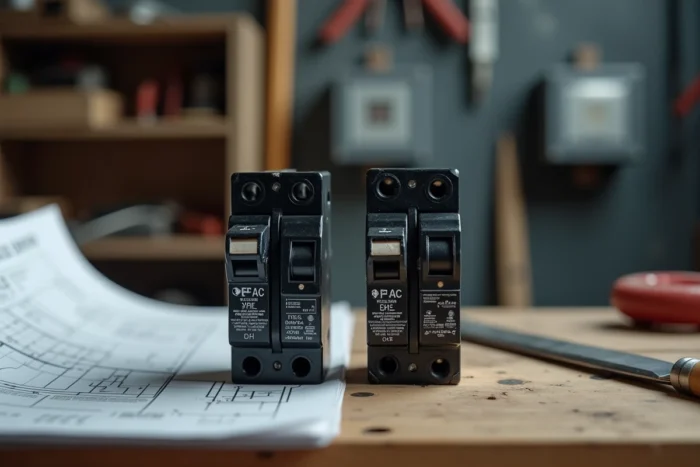
Mandatory circuits under type A according to the NF C 15-100 standard
The standard does not allow for choice on certain equipment. A type A differential switch must protect at least the following circuits:
- The cooktop or electric stove, whose power electronics generate rectified currents during temperature regulation.
- The washing machine, equipped with a variable speed motor controlled by a frequency converter, a common source of DC component in leaks.
- The charging station for electric vehicles (IRVE), which converts alternating current to direct current for the vehicle’s battery.
All other domestic circuits (lighting, general outlets, resistive heating, water heaters) can be connected under an AC type differential. The standard requires at least one type A and one type AC per panel.
Case of the IRVE charging station
Charging an electric vehicle illustrates the problem well. The vehicle’s onboard charger rectifies the current, and any potential leak almost always has a DC component. A standard AC differential may not trip, making type A mandatory on this circuit.
On the ground, IRVE installers tend to standardize type A devices across the entire dedicated row rather than mixing AC and A on a case-by-case basis. This approach simplifies wiring and avoids assignment errors during a later modification of the panel.
Generalizing type A across the entire panel: field trend or unnecessary cost
The increase in electronic loads in homes changes the game. Heat pumps, reversible air conditioning, photovoltaic panels with micro-inverters, connected appliances: the majority of recent devices come with switch-mode power supplies that can produce leaks with a DC component.
Some installers choose to only install type A differentials on all rows, including those supplying general outlets or lighting. This approach anticipates the future replacement of a resistive device with an electronic device, without having to revisit the panel.
There is an additional cost. A type A differential switch costs significantly more than its AC equivalent, at the same rating and sensitivity. For a panel with four rows, the total price difference remains moderate, but it is not negligible on a tight budget.
Feedback varies on this point: some electricians believe that type AC is perfectly suitable for lighting and resistive heating circuits, where the DC component is absent. Others prefer to standardize to avoid any unpleasant surprises in the medium term, especially in a new home designed to last several decades.

Common mistakes in the electrical panel and practical checks
The most common mistake is connecting a washing machine or induction cooktop under an AC type differential due to lack of space on the type A row. The circuit works normally on a daily basis, but protection against leaks with a DC component is no longer guaranteed. In the event of a Consuel inspection on a new installation, this point is checked.
Another trap: confusing differential switch and differential circuit breaker. The differential switch protects people against current leaks but does not detect overloads or short circuits. The differential circuit breaker combines both functions. In residential buildings, differential switches are generally installed at the head of the row, associated with branch circuit breakers on each circuit.
Check proper functioning
Each differential switch has a test button on the front. By pressing it, one simulates a current leak: the device should cut off immediately. This check should ideally be done once a month, regardless of the type (A or AC).
If the differential does not trip during the test, it must be replaced. A faulty device leaves the entire row without differential protection, exposing occupants to a risk of electrocution in case of an insulation fault.
Regulatory evolution NF C 15-100: what changes from 2025
The new edition of the NF C 15-100 standard, which is set to come into effect from September 2025 according to AFNOR, strengthens the requirements for differential protection. New residential installations will need to incorporate updated provisions, particularly to account for the generalization of charging stations and devices with electronic components.
Anticipating this evolution during a panel renovation helps avoid costly compliance later on. Installing type A on rows likely to host future electronic circuits remains the safest strategy, even if current regulations do not yet require it on all circuits.
The choice between type A and type AC boils down to the nature of the leakage current. For circuits at risk of a DC component, type A is indisputable. For the rest, type AC is technically sufficient, but the trend in the profession leans towards a broader adoption of type A, driven by the increasing electrification of homes.