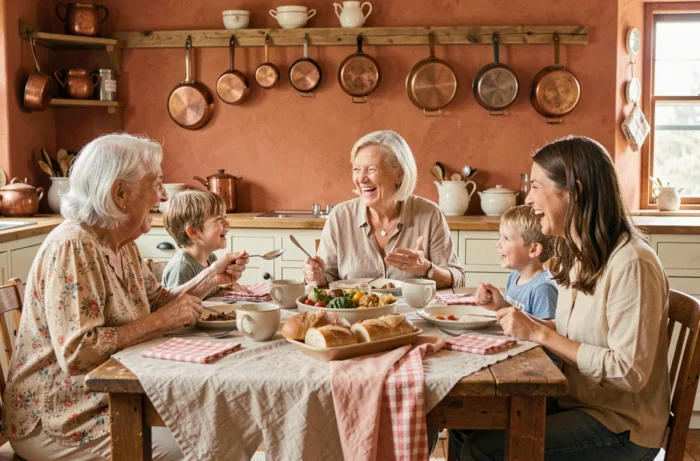
Family ties among seniors are rarely measured in the same way depending on whether the caregiver or the elderly person themselves is being asked. A weekly call may seem sufficient from the children’s perspective, while the parent feels a relational void for the rest of the week. This asymmetry in perception changes the approach to the issue: strengthening family ties in senior age is not just about increasing contacts, but about rethinking their quality.
Perception of family ties: what recent data shows
The report from the High Council for Family, Childhood, and Age adopted on February 20, 2024, provides a quantitative framework that sheds light on current family behaviors. Two data points structure the reflection.
| Indicator | Data | Evolution |
|---|---|---|
| Percentage of those aged 60 and over living in ordinary housing | 96 % | Stable |
| Percentage of those over 75 in ordinary housing | 90 % | Stable |
| French people refusing institutional care in case of loss of autonomy | 74 % | Increasing |
| Relatives willing to care for a dependent parent at home | 44 % (compared to 25 % in 2014) | Nearly doubled in ten years |
The proportion of relatives willing to support a dependent parent at home has nearly doubled in a decade. This shift changes the family dynamic: the bond is no longer just emotional; it becomes organizational.
Families that strengthen their relationships in senior age now do so in a context where the home remains the dominant living environment after 75. Generic advice on visits to nursing homes therefore only covers a minority of real situations.
To learn more about La Revue des Seniors, the topic of intergenerational relationships in daily life is addressed from several practical angles.
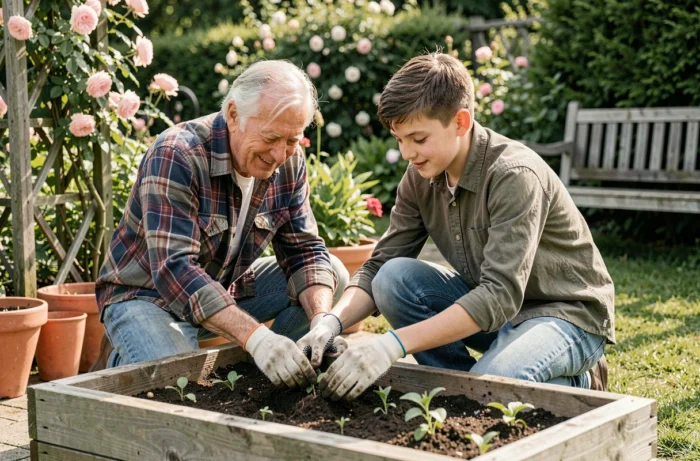
Family caregivers and seniors: two different perspectives on the same bond
A caregiver who calls every Sunday and manages medical appointments may feel they are fully fulfilling their role. The elderly parent, however, may feel isolated for the other six days of the week. This divergence in perception is a blind spot in support systems.
Co-constructing rituals rather than imposing them
A family ritual works when it is defined together. Setting a video call slot without asking the senior what time suits them is akin to organizing their social life for them. Co-construction requires an explicit exchange about each person’s expectations.
- Ask the parent which day and time they prefer for a call, rather than choosing the slot that suits the children
- Alternate formats: short calls during the week, visits or shared activities on weekends, letters or photos sent in between
- Include the senior in family group decisions (vacations, meals, event organization) instead of just informing them
A bond that is imposed does not have the same effect as a chosen bond. Research on the isolation of elderly people distinguishes between objective loneliness (number of contacts) and subjective loneliness (feeling connected). Increasing the frequency of visits without changing their content only affects the former.
Support systems for caregivers that structure family life
Strengthening family ties does not rely solely on goodwill. In recent years, several systems have been established to frame and concretely support family caregivers, freeing up time for quality interactions rather than pure logistics.
Caregiver leave and daily allowance (AJPA)
Caregiver leave allows an employee to temporarily suspend their activity to assist a parent losing autonomy. The daily allowance for caregivers (AJPA) provides compensation during this period. For situations of high dependency, compensation through the APA can complement the system.
These aids transform the volunteer caregiver into a recognized actor in home care. Their existence changes the nature of the bond: the relative is no longer just a visitor; they become a daily partner, with a status and rights.
What the aids change in the relationship
When the caregiver is exhausted by administrative management and care, the moments spent together become functional. Access to a relief (day care, home help, psychological support) allows for non-medicalized interactions: a walk, a shared meal, a conversation without a to-do list.
Intergenerational activities at home: three effective formats
Shared activities between seniors and grandchildren or adult children produce measurable effects on the well-being of both parties. Three formats stand out for their simplicity of implementation at home.
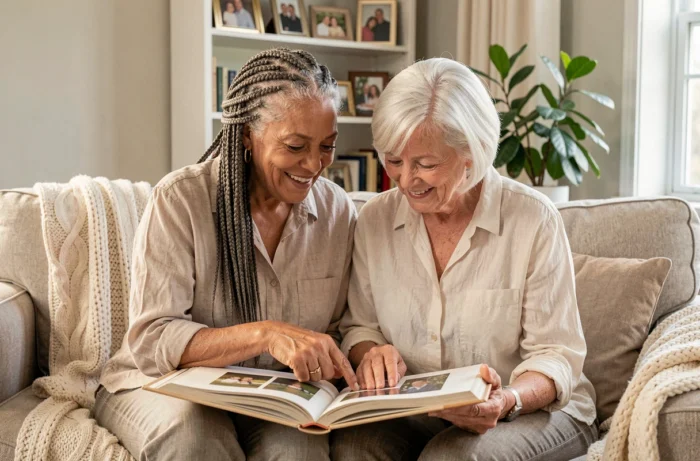
- Transmitting know-how (cooking, gardening, sewing, DIY): the senior regains an active and rewarding role, while the child or grandchild learns something concrete
- A joint project at a distance (digital photo album, monthly family newsletter, shared music playlist): each member contributes at their own pace without pressure to synchronize
- Adapted cultural or outdoor outings: a visit to a market, a trip to the park, a local exhibition, tailored to the senior’s actual mobility rather than an ambitious schedule
The common point of these three formats: the senior is not a spectator. They participate, choose, propose. Intergenerational cohabitation, which is gaining ground as a solution against isolation, is based on the same principle: sharing daily life rather than occasional visits.
Social life of seniors on a daily basis: beyond the family circle
Focusing all efforts on family ties can create an emotional dependency that weakens the senior if a relative distances themselves or disappears. Relationships with neighbors, associations, and activity groups complement the social fabric and make it more resilient.
A senior with three distinct social circles copes better with the loss of a contact than a senior whose entire relational life depends on their children. The family plays a foundational role, not a totality.
Staying at home, chosen by the vast majority of those over 60, implies that these circles are built locally. Home services, group solutions in the neighborhood, and neighborhood initiatives contribute as much to social ties as family calls.
Strengthening family ties in senior age involves less multiplying contacts than adjusting them to the real expectations of the elderly person. Data shows that families are more involved than they were ten years ago in home care. The next step is to transform this logistical involvement into quality relational time, which requires effectively mobilized support systems and rituals defined by mutual agreement.