Diving encompasses very different practices, from simple breath-holding to exploring submerged caves with heavy technical equipment. Each type of diving imposes its own constraints regarding training, equipment, and physical condition. Understanding these differences before getting started avoids unpleasant surprises and guides you towards the discipline best suited to your expectations.
French regulatory framework: what changes for instructors in 2027
A point rarely addressed in beginner guides concerns the regulations governing instructors. In France, a decree of August 4, 2026 creates a new mention of BPJEPS titled “underwater diving activities without aqualung.” This mention specifically targets the supervision of snorkeling and freediving.
The transition period runs until 2028. Starting May 1, 2027, no new training sessions under the old system (decree of December 1, 2016) will be allowed. The old text will be repealed on May 1, 2028.
For a beginner, this reform has a concrete consequence: structures offering introductory sessions for freediving or snorkeling will need to employ instructors holding the new mention. Checking the instructor’s qualifications before booking an initiation remains a basic precaution, and this regulatory evolution makes it even more relevant. The detailed sheets available about the Sortie 24 site help better situate each discipline before choosing your supervision.
Scuba diving, freediving, and snorkeling: three disciplines, three logics
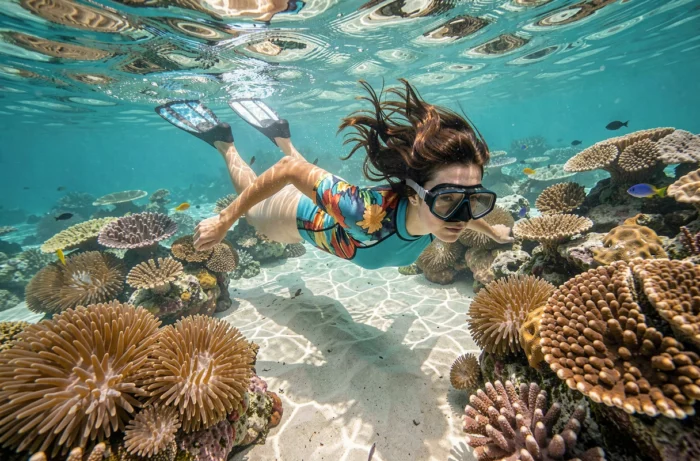
The fundamental distinction is based on a single criterion: the source of air. Either the diver breathes at the surface and holds their breath (freediving), or they carry their air in compressed form (scuba diving), or they stay on the surface with a snorkel (snorkeling). Everything else follows from this.
Scuba diving: mandatory training and heavy equipment
Scuba diving requires structured learning. In France, the sports code distinguishes between supervised diving skills (PE) and autonomous diving skills (PA), with each level granting access to different maximum depths. International certifications (PADI, SSI) follow a similar logic with their own levels.
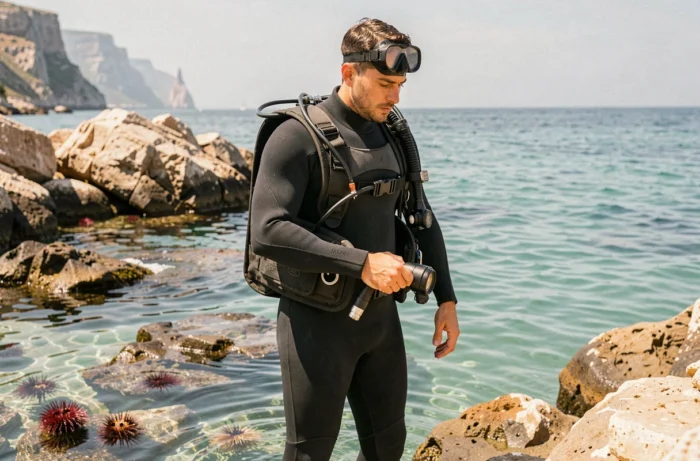
The basic equipment includes a tank, regulator, buoyancy control device, and wetsuit. Each element has a specific role in managing breathing, buoyancy, and thermal comfort. The total weight of the equipment, carried out of the water, represents a real physical constraint that beginners often underestimate.
Freediving: a technical discipline in its own right
Freediving is not just “diving without a tank.” It involves specific breathing techniques, work on muscle relaxation, and precise management of ear equalization. Freediving training follows its own progression, distinct from that of scuba diving, with dedicated levels.
Field feedback varies on whether freediving serves as a good entry point to scuba diving or if the two disciplines benefit from being learned separately. The respiratory habits differ profoundly: in freediving, you hold your breath, while in scuba diving, never blocking your breath is the most fundamental safety rule.
Snorkeling: the lowest entry threshold
Snorkeling requires only a mask, snorkel, and fins. No certification is required, and the practice remains at the surface or at shallow depths. It is the most accessible discipline for discovering the underwater environment, but it remains limited in terms of exploration.
Wreck diving, night diving, and drift diving: the specializations
Beyond the distinction between scuba and freediving, diving is divided into specializations that radically change the experience. Three of them deserve attention because they raise distinct safety questions.
- Wreck diving: exploring submerged structures (boats, planes, infrastructures) combines navigation in confined spaces and risks of physical traps (cables, sheets). Specific training is recommended before any penetration inside a wreck.
- Night diving: the loss of visual references alters the perception of depth and orientation. Lighting equipment (main light and backup light) becomes a safety tool, not a comfort accessory.
- Drift diving: the diver lets themselves be carried by the current, allowing for covering large distances with little effort. However, managing the ascent and recovery by the support boat requires precise coordination with the supervision.
Each of these specializations assumes prior mastery of the fundamentals of scuba diving. Certification organizations offer additional modules for each type, but the required level varies by organization and country.
Choosing your diving equipment as a beginner
A common mistake is to buy equipment before defining your practice. A scuba diver in temperate waters does not have the same needs as a freediver in warm seas.
- The wetsuit is chosen based on water temperature, not the type of diving. In cold waters, a thick or semi-dry suit is necessary, regardless of the level.
- Fins vary by discipline: short and flexible fins for snorkeling, longer and stiffer fins for freediving, and full-foot fins with booties for scuba diving.
- The regulator and buoyancy control device only concern scuba diving. At the beginning of practice, renting at a dive center allows you to test different models before investing.
- The mask is the only common element across all disciplines. An ill-fitting mask ruins any dive, regardless of the rest of the equipment.
The budget question arises differently depending on the discipline. Snorkeling requires minimal investment. Freediving requires moderate equipment. Scuba diving represents the highest cost, especially if you buy your own tank and regulator.
The choice of diving type depends as much on physical condition and budget as on the attraction to a particular environment. Testing several disciplines during introductory sessions or courses remains the most reliable method to identify the one that meets your expectations before committing to a full training program.