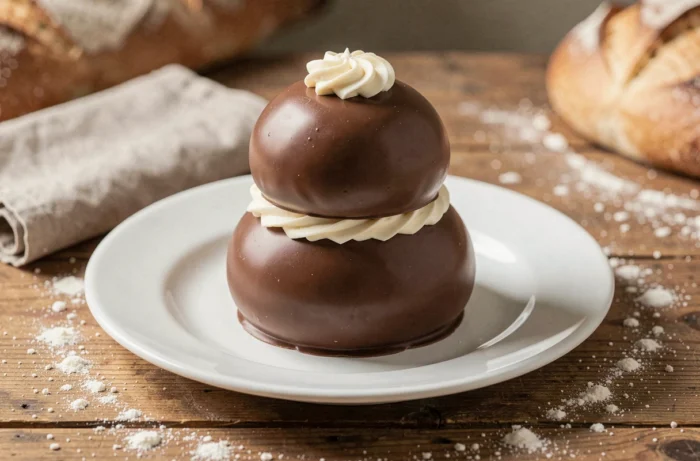
When ordering a tray of religieuses for an event, the first practical question that arises concerns the format. Should one go for standard individual pieces or opt for mini ones to vary the flavors? The religieuse in French pastry does not adhere to any official size standard, and it is precisely this ambiguity that generates notable discrepancies from one artisan to another, from one display case to another.
However, stable references can be found in professional practice. The so-called classic format consists of two stacked choux, with the larger one forming the base and the smaller one serving as the head. The total height of an individual religieuse is around ten centimeters, with a base diameter that remains smaller than that of a flat éclair. This size allows for proper holding of the pastry cream inside the choux, without premature sagging in the display case.
Individual religieuse and selling weight: what the format implies
In artisanal shops, the religieuse is sold as an individual piece. The weight varies depending on the thickness of the choux pastry, the density of the cream, and the amount of fondant glaze applied. It is observed that some retail brands offer religieuses packaged in pairs for a total weight of about 250 g, which gives an indication of the commercial size of a single piece.
This packaging in batches alters the perception of the product. An artisanal religieuse weighs significantly more than an industrial version, because the buttercream used for decoration and the more generous filling weigh down the piece. An artisan who fills their choux with a pastry cream rich in egg yolks and whole milk achieves a denser result than a lighter filling.
To fully understand the classic size of a religieuse and its implications on weight, one must distinguish between the external structure (choux pastry, fondant, decorative buttercream) and the internal filling (pastry cream with chocolate, coffee, or vanilla).
Mini-religieuses for events: a format that changes the constraints
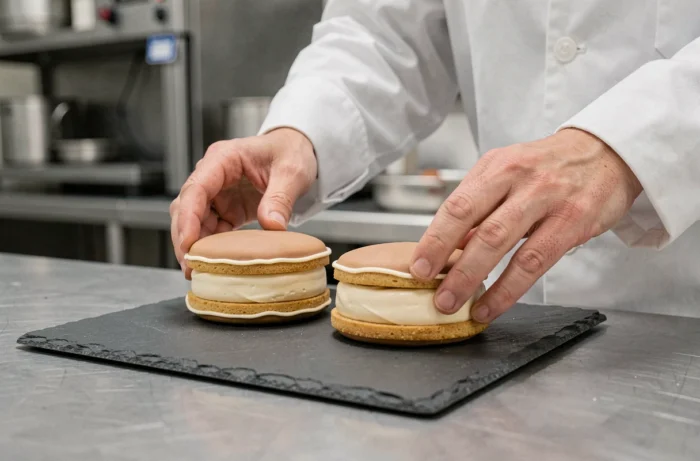
Mini-religieuses are not simply smaller versions of religieuses. The transition to a smaller format alters the proportion between choux pastry and filling. On a miniature piece, the thickness of the choux shell represents a larger share of the total volume. The amount of pastry cream is therefore proportionally reduced.
In practice, this format is mainly used for buffets and tasting platters. Three or four different flavors (chocolate, coffee, vanilla, pistachio) can be offered where an individual format forces the guest to choose just one flavor.
- The shelf life in a refrigerated display is shorter for minis, as the fondant glaze deteriorates faster on a small diameter rounded surface
- The assembly requires more precision: the head choux must remain proportionate so that the silhouette remains recognizable
- The unit cost decreases, but the production time per piece remains almost identical to that of a standard religieuse, which explains a higher price per kilo
Feedback varies on this point, but several professionals report that minis sell better in assortments than individually.
Choux pastry and fondant glaze: two variables that dictate the final format
The size of a religieuse primarily depends on the piping diameter of the choux pastry. In the workshop, a plain nozzle is used to form the base choux, followed by a smaller nozzle for the top choux. The ratio between the two choux determines the visual balance of the finished piece.
A base choux piped too wide will spread during baking and produce a squat religieuse. Conversely, a tight piping gives a tall piece but is more fragile during assembly. Baking also plays a role: a well-dried choux pastry over the heat before piping will puff up more in the oven, increasing the final volume without adding weight.
The role of fondant in the perception of size
The fondant glaze covers each choux before assembly. An overly thick fondant weighs down the piece and obscures the reliefs of the choux pastry. Artisans who work with warmed fondant at the right consistency achieve a thin, shiny layer that respects the proportions of the choux without adding unnecessary volume.
On chocolate religieuses, the chocolate fondant is often slightly thicker than on a coffee version, because cocoa powder alters the viscosity of the mixture. This technical detail has a direct impact on the final appearance: the chocolate religieuse often appears a bit more massive than its coffee cousin, with the same choux diameter.
Traditional religieuse and modern religieuse: two distinct silhouettes
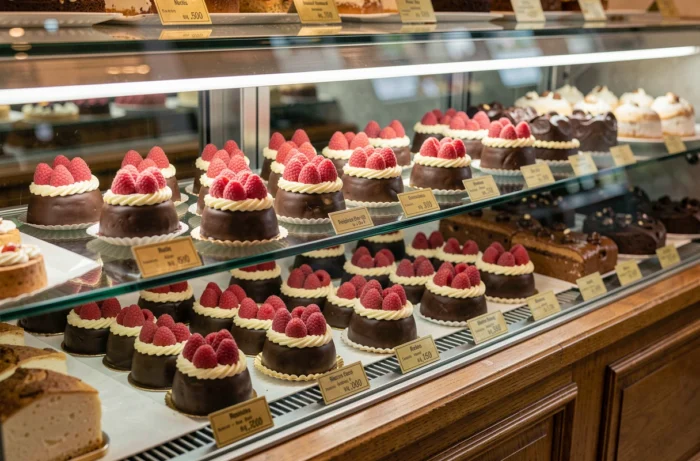
The religieuse as we know it today, with its two stacked round choux and buttercream collar, differs from the historical version. The traditional religieuse adopted a pyramidal shape, constructed from several elements of choux pastry arranged in tiers. This version, revived in some pastry schools, produces a taller and more imposing piece than the two-choux model.
The modern two-choux format has become established for practical reasons. It is faster to make, easier to transport, and offers a more generous filling-to-structure ratio. The pastry cream occupies the center of each choux, while the buttercream is only used for exterior decoration, in a collar between the two tiers and sometimes in rosettes on top.
Flavors and contemporary variations
Classic flavors remain chocolate and coffee, two flavors that naturally pair with fondant as a glaze. Modern variations incorporate fruity flavors (strawberry, raspberry) or combinations like vanilla-praline.
- Chocolate religieuses generally use a pastry cream enriched with cocoa or melted chocolate, with a matching fondant
- Coffee versions rely on a concentrated coffee extract incorporated into the cream and fondant
- Fruity variations sometimes replace the fondant with a colored mirror glaze, which alters the appearance but also the preservation of the piece
Regardless of the chosen flavor, the basic format remains the same: two choux, one filling, one glaze. The size adapts to the use, whether individual or bite-sized, but the structure of the French religieuse does not change. It is this consistency that makes it a reliable reference in display cases, from the Parisian tearoom to the neighborhood bakery.